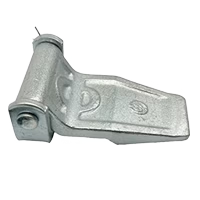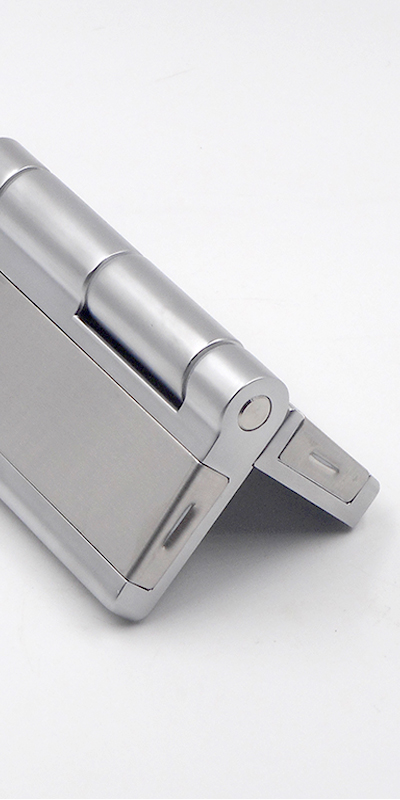

Steel butt hinges are the standard workhorse of industrial hinge applications.
Steel butt hinges are two rectangular plates joined by a pin, designed to allow doors or panels to open and close along a fixed axis. They’re typically installed by welding or screwing into the edge of a door and its frame. Their strength, compact shape, and ease of installation make them ideal for industrial enclosures, equipment panels, and control cabinets.
In practice, choosing the right hinge isn’t just about size or shape.
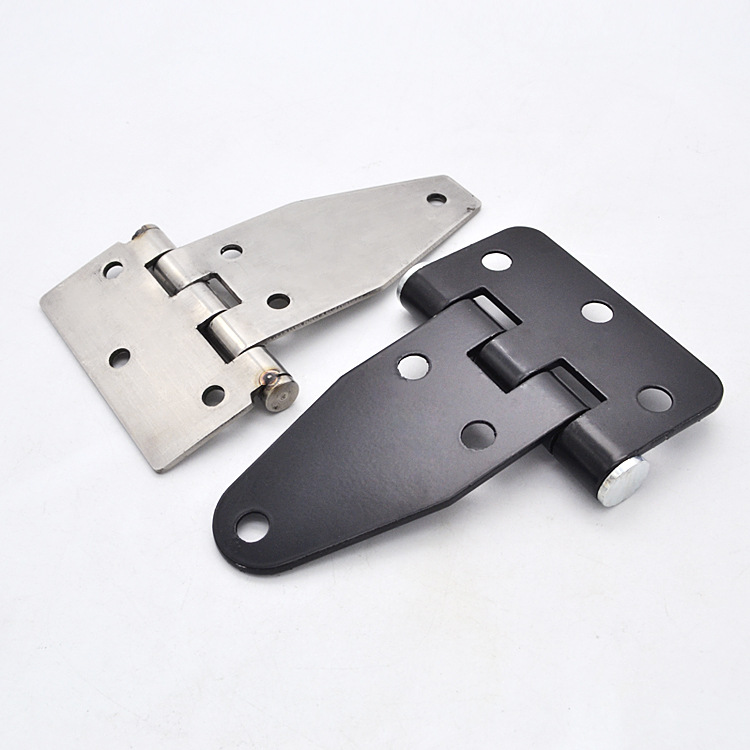
What Are Steel Butt Hinges?
Steel butt hinges consist of two identical leaves connected by a central pin, allowing the leaves to rotate around the pin axis. In industrial settings, these hinges are often mounted flush between a door and its frame. They are usually fabricated from cold-rolled or hot-rolled steel and may be plated with zinc or chrome to resist corrosion.
Why steel, not stainless?
Many clients assume stainless steel is the best choice for durability. But in reality, for indoor or mildly corrosive environments, cold-rolled steel with a quality surface coating can outperform stainless on price and customization flexibility. For example, in electrical enclosures used in production facilities, zinc-plated steel butt hinges offer better welding compatibility and cost-effectiveness compared to stainless options.
Key dimensions and variations
Common specs include leaf thickness (typically 2.0-6.0mm), pin diameter (4.5-12mm), and knuckle length. Some butt hinges include fixed pins for security, while others are detachable for easy maintenance. Others are customized for load-bearing strength with full-length pins or added knuckle reinforcement.
| Spec | Range |
|---|---|
| Leaf Thickness | 2.0mm – 6.0mm |
| Pin Diameter | 4.5mm – 12mm |
| Material | Cold-rolled steel, hot-rolled steel |
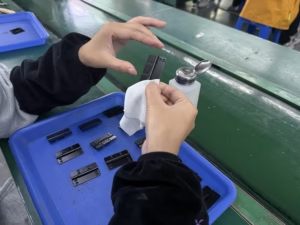
| Surface Finish | Zinc-plated, chrome-plated, electrophoresis |
How to Choose the Right Steel Butt Hinge
Choosing a hinge starts with understanding the load and environment. In industrial applications, this is rarely as simple as measuring weight. Engineers must account for door dimensions, swing frequency, and vibration.
Application-specific factors
Take my advice: always evaluate the hinge based on how the door behaves when installed. For instance, a sheet metal box manufacturer once selected a 3mm thick hinge for a large cabinet door, focusing only on static weight. But once the box was mounted on-site, wind gusts and user slamming caused torsional fatigue and misalignment. A better fit would have been a 5mm thick hinge with longer leaves for load dispersion.
Mounting method
Weld-on steel butt hinges are common in heavy-duty settings like trailer doors or generator boxes. But for thinner enclosures, screw-on types are easier to align and replace. Always confirm your mounting method before finalizing hole patterns.
Hidden pitfalls
Many buyers overlook hinge tolerance, especially pin clearance. If your application involves dust, vibration, or heat, loose tolerances will cause long-term rattle or sag. At IHINGES, we offer tight-clearance hinge options with CAD-confirmed fit before production.
Conclusion
Steel butt hinges are simple in appearance but highly variable in function. Choosing the right one requires matching spec to real-world behavior.
If your project requires hinges that cannot be standardized, IHINGES is built for that exact need.
IHINGES is the world’s only manufacturer dedicated exclusively to custom industrial hinges, focusing on real industrial applications rather than off-the-shelf products.